
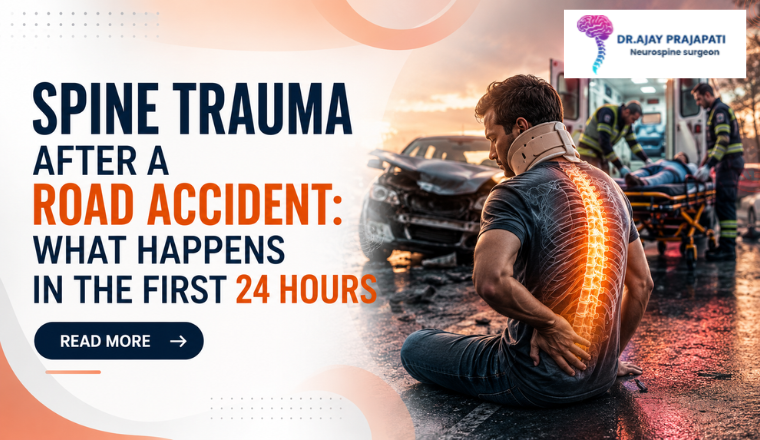
Spine Trauma After Road Accident: First 24 Hours | Best Neurosurgeon in Noida
Introduction
A road accident happens in seconds. The consequences — particularly to the spine — can last a lifetime. India records one of the highest rates of road traffic accidents in the world, and spinal cord injuries are among the most devastating outcomes. What makes spine trauma uniquely critical is this: the decisions made in the first 24 hours after injury can determine whether a patient walks again.
Yet most accident victims — and the bystanders who try to help them — are unaware of what to do, what not to do, and what is happening inside the spine during those crucial hours. This blog is a clear, medically accurate guide to understanding spine trauma after a road accident — from the moment of impact to the first 24 hours of medical management.
Understanding the Spine: What Is Actually at Risk?
The spine is a column of 33 vertebrae stacked upon each other, protecting the spinal cord — the brain's primary communication highway to the rest of the body. Every movement, every sensation, every function below the neck depends on the integrity of this structure.
In a high-velocity road accident, the spine is subjected to forces it was never designed to withstand:
- Flexion-extension (whiplash) — the head snaps forward and backward violently
- Axial compression — the spine is crushed vertically, as in a head-on collision
- Rotation — twisting forces that shear vertebrae against each other
- Distraction — the spine is pulled apart, as in certain seat belt injuries
Any of these mechanisms can cause fractures, dislocations, ligament tears, disc herniations, or direct spinal cord compression — often in combination. The cervical spine (neck) and thoracolumbar junction (lower back) are the two regions most vulnerable to traumatic injury.
The First Moments: What Is Happening Inside the Spine
When the spine sustains traumatic injury, two distinct processes begin simultaneously — and understanding both is essential.
Primary Injury
This is the direct mechanical damage that occurs at the moment of impact:
- Vertebral fractures and bone fragments that penetrate the spinal cord tissue
- Ligament ruptures that destabilise the spinal column
- Disc herniations that compress nerve roots or the spinal cord
- Direct bruising or laceration of spinal cord tissue
Primary injury is instantaneous and irreversible. No medical intervention can undo the damage that has already occurred at the moment of impact.
Secondary Injury
This is where medicine can make a life-changing difference. In the minutes and hours following the primary injury, a cascade of damaging biological processes begins:
- Oedema (swelling) — the injured spinal cord swells within the rigid spinal canal, compressing itself further
- Ischaemia — reduced blood flow to injured cord tissue causes progressive cell death
- Inflammation — immune cells flood the injury site, releasing chemicals that damage surrounding healthy tissue
- Haemorrhage — bleeding within or around the cord increases compression
- Electrolyte imbalance — disruption of cellular ion channels leads to neuronal death
Secondary injury is progressive — and it is largely preventable with rapid, expert medical intervention. This is why the first 24 hours are not just important. They are decisive.
At the Scene: What Bystanders Must and Must Not Do
The actions of bystanders in the minutes following a road accident can significantly affect the severity of spinal injury. Here is what everyone should know:
DO:
- Call emergency services immediately — every minute without medical care worsens secondary injury
- Keep the victim still — do not allow movement of the head, neck, or spine
- Speak calmly to the victim and reassure them — panic causes involuntary movement
- If the victim must be moved (due to fire or immediate danger), support the entire spine as a single rigid unit — use the log-roll technique with multiple people
- Note the time of injury — this information is critical for the medical team
DO NOT:
- Do not move the victim unnecessarily — even a well-intentioned movement can convert an incomplete injury into a complete one
- Do not remove a helmet from a motorcyclist unless necessary for airway management
- Do not allow the victim to sit up, stand, or walk
- Do not place a pillow under the head — this flexes the cervical spine and worsens compression
- Do not give water or food — aspiration risk and pre-operative considerations
Arrival at the Emergency Department: The First Hour
Once the victim reaches a hospital, the trauma team activates a coordinated, time-critical protocol.
Primary Survey (ABCDE)
The priority is always life over limb:
- Airway — securing the airway while maintaining cervical spine alignment
- Breathing — assessing respiratory function (cervical injuries can paralyse breathing muscles)
- Circulation — controlling haemorrhage and maintaining blood pressure
- Disability — rapid neurological assessment using the GCS (Glasgow Coma Scale)
- Exposure — full exposure of the body to identify all injuries
Neurological Assessment
A detailed neurological examination is performed to establish the ASIA Impairment Scale grade — the internationally used classification of spinal cord injury severity:
- ASIA A: Complete injury — no motor or sensory function below the injury level
- ASIA B: Sensory incomplete — sensation preserved, but no motor function
- ASIA C: Motor incomplete — some motor function present but weak
- ASIA D: Motor incomplete — useful motor function preserved
- ASIA E: Normal — full motor and sensory function
This baseline assessment is critical. Any deterioration from this baseline in the following hours indicates worsening secondary injury and may necessitate emergency surgical intervention.
Emergency Imaging
Imaging is initiated rapidly and in parallel with clinical assessment:
- CT Scan of the entire spine — the first-line imaging modality in trauma; rapidly identifies fractures, dislocations, and bone fragments
- MRI Spine — performed as soon as the patient is stabilised; provides detailed information about spinal cord compression, disc herniation, ligament injury, and haemorrhage
- CT Angiography — if vascular injury to the vertebral or carotid arteries is suspected
Hours 2–6: Stabilisation and Decision-Making
Once imaging is complete, the trauma and neurosurgical team evaluates the full picture and makes critical treatment decisions.
Spinal Immobilisation
The injured spine must be immobilised to prevent further displacement and secondary injury:
- Cervical collar — for neck injuries
- Spinal board or vacuum mattress — to maintain full spinal alignment during transport and evaluation
- Traction — for certain cervical fracture-dislocations, traction reduces displacement and decompresses the cord
Blood Pressure Management
Maintaining mean arterial pressure (MAP) above 85–90 mmHg is a critical goal in the first 24 hours of spinal cord injury management. The injured spinal cord loses its ability to autoregulate blood flow — falling blood pressure means falling perfusion of the cord, which accelerates ischaemic cell death.
This is why aggressive fluid resuscitation and, in some cases, vasopressor support are initiated early in spinal cord injury management.
Surgical Decision-Making
The most consequential decision in the first 24 hours is whether the patient needs emergency surgery — and if so, how urgently.
Emergency surgery is indicated when:
- There is evidence of incomplete and worsening neurological deficit — a patient who is deteriorating has a compressing lesion that must be removed immediately
- Spinal instability — fractures or dislocations that place the cord at ongoing risk of further injury
- Traumatic disc herniation causing cord compression
- Open spinal injuries — lacerations exposing the spinal canal
- Vascular injury to the spinal cord blood supply
Current evidence strongly supports early surgical decompression within 24 hours for incomplete spinal cord injuries. Multiple studies, including the landmark STASCIS trial, demonstrate that surgery within 24 hours is associated with significantly greater neurological recovery compared to delayed surgery.
Hours 6–24: Surgery, Monitoring, and Neuroprotection
Surgical Procedures in Spinal Trauma
The specific procedure depends on the injury pattern:
Anterior Cervical Discectomy and Fusion (ACDF) For cervical spine injuries with disc herniation and cord compression — the damaged disc is removed from the front of the neck, and the vertebrae are fused for stability.
Posterior Decompression and Instrumented Fusion. For unstable fractures, the spine is stabilised with pedicle screws and rods from behind, while bone fragments compressing the cord are removed.
Corpectomy: When a vertebral body is shattered, it is removed entirely and replaced with a cage and bone graft, restoring alignment and decompressing the cord.
Laminectomy: Removal of the lamina to expand the spinal canal and relieve pressure on the cord — used in stenotic injuries or posterior compression.
The technical demands of these procedures in a trauma setting — with unstable spines, swollen tissue, and complex anatomy — make the experience of the operating neurosurgeon paramount. The best spine specialist in Noida with dedicated trauma neurosurgery experience is equipped to navigate these challenges and achieve the best possible surgical outcome.
Intensive Care Monitoring
Following surgery, patients are managed in the ICU with:
- Continuous blood pressure monitoring and MAP optimisation
- Neurological checks every 1–2 hours to detect deterioration
- Ventilatory support if breathing is compromised (common in cervical injuries)
- Prevention of secondary complications: deep vein thrombosis, pressure ulcers, urinary tract infections, and pneumonia — all of which can begin developing within the first 24 hours if not actively prevented
What Determines Neurological Recovery?
Several factors influence how much function a patient recovers after spinal trauma:
- Completeness of injury — incomplete injuries (ASIA B, C, D) have significantly better recovery potential than complete injuries (ASIA A)
- Level of injury — cervical injuries affect more of the body than thoracic or lumbar injuries
- Time to decompression — early surgery within 24 hours offers the best recovery window
- Age and overall health — younger, healthier patients generally recover more function
- Quality of rehabilitation — aggressive, early physiotherapy and occupational therapy are essential for maximising long-term recovery
Patients managed by an experienced multidisciplinary team — led by the best neurosurgeon in Noida — consistently demonstrate better neurological outcomes, fewer complications, and faster rehabilitation progress than those managed at centres without specialised spine trauma expertise.
Frequently Asked Questions (FAQs)
Q1. Can spinal cord damage from a road accident be reversed?
Incomplete injuries treated early have recovery potential; complete injuries are generally permanent.
Q2. How soon after a spine injury should surgery be performed?
Within 24 hours, earlier decompression consistently delivers better neurological outcomes.
Q3. What is the most dangerous mistake bystanders make at accident scenes? Moving the victim without spinal precautions — it can turn a partial injury into a complete one.
Q4. Can secondary spinal cord injury be prevented?
Yes — rapid expert medical care significantly limits swelling, reduces blood flow, and nerve damage.
Q5. Where should spine trauma patients in Noida seek emergency care?
Consult the best spine specialist in Noida immediately — do not delay emergency evaluation.
Conclusion
Spine trauma after a road accident is a race against time — and the clock starts at the moment of impact. The primary injury cannot be undone, but the secondary injury that follows can be controlled, limited, and in many cases, significantly reversed with rapid expert intervention.
From the actions of bystanders at the accident scene, to emergency stabilisation in the trauma bay, to imaging, decision-making, and surgery within the critical 24-hour window — every step matters. Every minute of delay in decompressing a damaged spinal cord is a minute of irreversible neurological loss.
If someone you know has suffered a road accident with a suspected spine injury, do not wait. Do not hope it will resolve. Seek immediate evaluation at a centre equipped for spine trauma — and ensure they are treated by the best neurosurgeon in Noida with the expertise to navigate this most critical of medical emergencies.
The spine does not get a second chance. Neither should care.
📌 Disclaimer: This blog is for informational purposes only. Always seek immediate emergency medical care for any suspected spinal injury. Do not rely on this content as a substitute for professional medical evaluation and treatment.